

Past performance should not be taken as a guide to future performance. The value of investments, and the income from them, can fall as well as rise and you may not get back what you put in. You should continue to hold cash for your short-term needs.
Overlay

Mid-year Investment Outlook 2025



What we're doing
The investment team at Coutts, the asset managers behind Royal Bank Invest, held their nerve as markets fell. The team have preferred global stocks since 2023, holding more in our funds compared to their benchmark. This meant that it was an uncomfortable few weeks as market volatility unfolded.
But it was a smart move to stay invested during the uncertainty. Selling out when markets were trending down would’ve meant cementing those losses and missing out when markets recovered.
It’s hard to ignore the fact that economic risks have risen and the possibility of a recession has edged higher. However, we don’t think this will become a reality given how strong the economy was before tariffs pressured markets.
This is why the team reduced their investments in global equities in May, but still remain modestly overweight. Should the political trade story evolve, they’re ready to take action within our funds.

Our investment strategy
The investment strategy behind our funds is guided by two processes: Anchor and Cycle. They focus on two different time horizons, complementing each other to determine which investment options could offer the best future returns depending on the amount of risk that comes with it.
Anchor
This is the long-term strategic model (up to five years). Looking at the universe of potential investments, the process calculates each investable option’s potential return while taking into consideration if its initial price appears cheap or expensive, and other factors such as economic growth and inflation.
Information Message
Cycle
Focusing more on the shorter term, this is our tactical engine. Over the next 12-18 months, the team finds that asset performance is driven by shifts in the business cycle, and their impact on investor sentiment and company earnings.
Our investments lean into risky assets like stocks when the economic environment is supportive. And turn to more defensive positions when conditions appear more challenging.
Information Message


Some key drivers include:
Artificial intelligence (AI): Each quarter, companies announce how their business performed for the last three months and what they expect for the future. The buzzword that remains in these messages for many is AI. More and more companies are adopting it into their business strategies to become more efficient in an attempt to boost profits. This ranges from coding to customer service to marketing and so could be a dominant driver of stock market performance from all sectors.
Japan: Share buybacks in Japan’s stock markets grew by 70% year-on-year in 2024. A share buyback is when a company buys its own shares to return excess cash to its investors. Since last year, the amount companies have been buying back has been growing significantly – roughly £35 billion for the first four months of this year (source: NikkeiAsia).

Managing risk
Government bonds – In the past, government bonds helped investors during recessions: Economy contracts. Stocks go down. Central banks cut interest rates. Bond prices go up. While factors such as inflation mean rates might not be able to come down as freely, government bonds may still offer some protection.
Liquid alternatives – Unusually, stocks and bonds have been more positively correlated – moving in the same direction. This has increased the need for other diversifiers in some of our funds. The team has included a liquid alternatives fund which uses strategies that move independently from stock and bond markets.
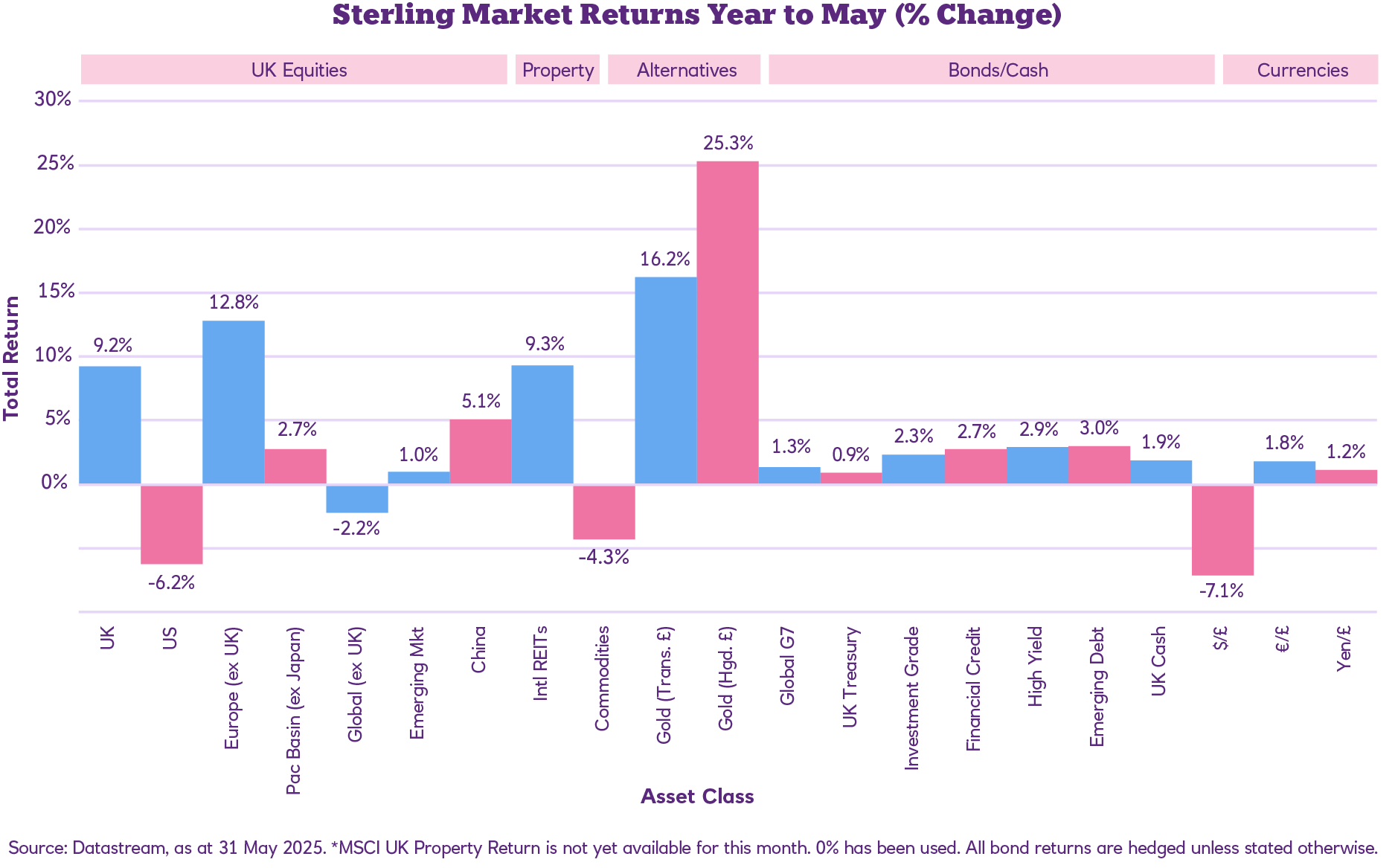
Pound sterling – We have a positive outlook on the pound compared to the US dollar which has been declining so far this year. We still see the dollar as overvalued, so we’ve hedged some of US investments in pounds. This helped mitigate some of the losses when stock markets recovered in April but the weak dollar meant returns were still down.
What’s coming next
We don’t expect the tariff story to go away any time soon. It’s likely the economy slows down and inflation will pick up pace. But it’s worth highlighting that tariffs aren’t the only thing on President Trump’s agenda while in the White House.
A bill is currently in the works for personal and corporate tax cuts which would be a boost for the economy. The bill would mean the US government potentially takes on more debt, though it could also encourage consumer and corporate spending.
So we see a more balanced picture ahead. This is only the beginning of Trump’s administration and so we expect more new policies alongside the refining of existing ones.
Information Message
Final thoughts
Big world events can make markets shift but this can sometimes be reactive and irrational, and markets usually return to focusing on the fundamentals.
Instead of reacting to every headline, we focus on our proven process. We look at things like company profits, economic growth, and central bank policies to guide our choices. That’s not to say we won’t face similar periods of discomfort in the near future, but we believe that those too could likely pass.
Information Message